5 Things the Creator Economy Can't Afford to Carry into 2026
The creator economy has matured but the way we operate hasn't. Here are 5 habits, myths, and gaps the influencer marketing industry needs to leave behind in 2026.

%20(1).png)
December means two things in influencer marketing: budget planning season and hot-take overload.
Every year, the think pieces roll in. Predictions, trend reports, “state of the industry” roundups. Most of it is noise.
What actually matters is this: the creator economy has matured, but the way we operate hasn’t. The same issues that held us back five years ago are still here, just wrapped in new language.
We don’t need another hot take. We need better foundations.
If 2026 is going to be a turning point, the industry needs to let go of what’s no longer working.
Here are five things to leave behind.
1. Rate chaos and unclear compensation structures
Pricing in influencer marketing is unpredictable. Rates swing wildly for the same deliverables. Markups are impossible to trace back to value. Scopes mean different things depending on who you ask.
This hurts everyone.
Creators are left guessing what fair compensation looks like. Brands can’t forecast accurately. Agencies are stuck renegotiating the basics every time.
This shouldn’t be the norm. The industry doesn’t lack talent, it lacks structure.
We need standardized scopes, transparent pricing, and shared definitions. Not to limit creativity, but to support it.
Clarity makes the work better, for everyone involved.
2. Narratives that don’t match the data
“Rates are skyrocketing.”
“Anyone can be a creator.”
“The creator economy is the Wild West.”
These lines are easy to repeat, and easier to misinterpret.
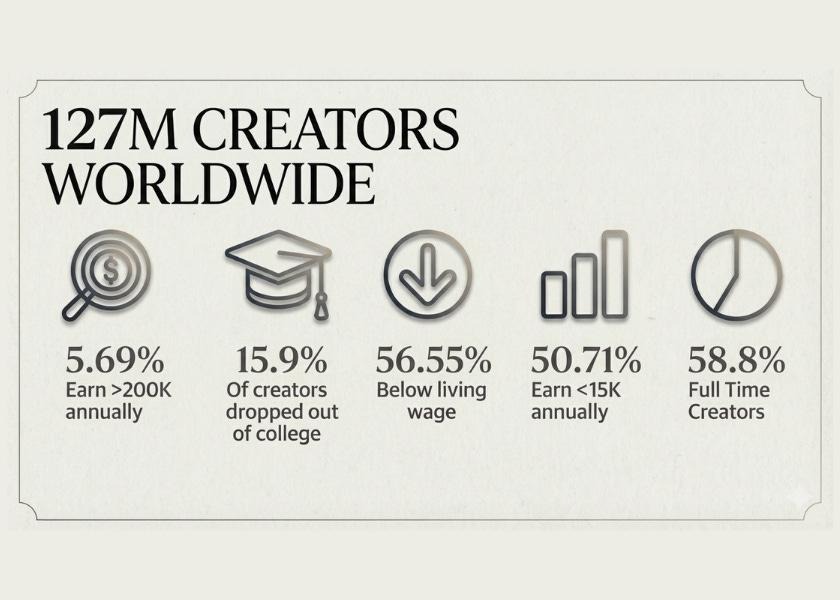
Rates aren’t rising across the board. They’re splitting. Top creators are commanding more, yes—but many others are seeing flat or lower fees, and much slower deal flow.
And while it’s never been easier to publish content, building an actual community is a different story.
Trust still matters. Content quality matters. Brand fit matters. This industry isn’t unstructured; it’s just misunderstood.
There are contracts, approval layers, licensing terms, legal reviews, and usage negotiations. The same as any other marketing discipline. But too often, those details get lost in favor of a good headline.
If the industry wants to move forward, it has to stop oversimplifying itself. By using data to shape narratives and pushing for clarity.
The sooner we stop selling the myth or the vibe, the sooner we can build something better.
influencermarketinghub.com
3. Treating creators like interchangeable ad units
Too often, creators are still treated like media placements. Slotted into plans as if they’re banner ads with a face.
But creators don’t just bring reach. They bring trust. Context. Cultural fluency.
They know what resonates with their audience, and how to deliver it in a way no brief can manufacture.
When brands approach influencer partnerships like programmatic buys, the work falls flat. The creative lacks depth. The messaging feels generic. And audiences can tell.
If you want performance, start with partnership.
That means involving creators earlier. Giving them room to shape the work. Thinking long-term, not one-and-done.
The most effective campaigns aren’t built on impressions. Impressions alone rarely tell the full story when it comes to sustained brand affinity or long-term business impact. Impression-led models can efficiently deliver visibility, but the strongest outcome is when that visibility is paired with belief: creator trust, message retention, repeat exposure, and audience–brand alignment
4. Oversimplified metrics that miss the full picture
A save is not the same as a share.
A view is not the same as a conversion.
A click does not always mean intent.
Influence works differently depending on format, platform, audience behavior, and content category. But too many brands still rely on surface-level metrics that don’t reflect how influence actually drives outcomes.
Performance measurement needs to account for the full funnel, not just top-line vanity metrics. We have the data. We need to use it properly.
5. Credibility without operational experience
Influencer marketing has never been louder. There are more voices, more playbooks, more “how to grow” and “how to create content” threads than ever before.
But in all that noise, real operational expertise often gets drowned out.

There’s a difference between having an opinion and having experience.
Knowing what should happen in theory isn’t the same as having worked through the realities. Tight timelines, legal reviews, usage negotiations, shifting scopes, late payments, performance pivots.
This work is messy. It’s nuanced. And it takes more than a personal brand to do it well.
The creator economy doesn’t need more noise. It needs leadership grounded in real execution.
Leadership from people who’ve shipped campaigns end-to-end. Managed real budgets with real constraints. Balanced creative vision with compliance, brand integrity, and measurable performance. People who understand that influence isn’t just a vibe — it’s a business channel with P&L impact.
Anyone can offer a hot take.
Far fewer can build the systems, guardrails, and teams that make influence sustainable at scale.
As we enter the next phase of this industry, clarity, discipline, and operator-level thinking will matter more than ever.
What comes next
The creator economy is not new anymore. We’re past the early-stage chaos. The question now is whether the industry is willing to build the operational foundations that real growth requires.
That means transparent compensation. Data-driven narratives. Relationship-focused partnerships. Nuanced measurement. And credibility that comes from actually doing the work.
2026 doesn’t need more predictions. It needs better systems.
What do you think the creator economy needs to leave behind? Reply and let me know.
Read more post











.png)